From Buddhist temples to churches, online places of worship offer a quiet escape for young people seeking comfort without religious commitments
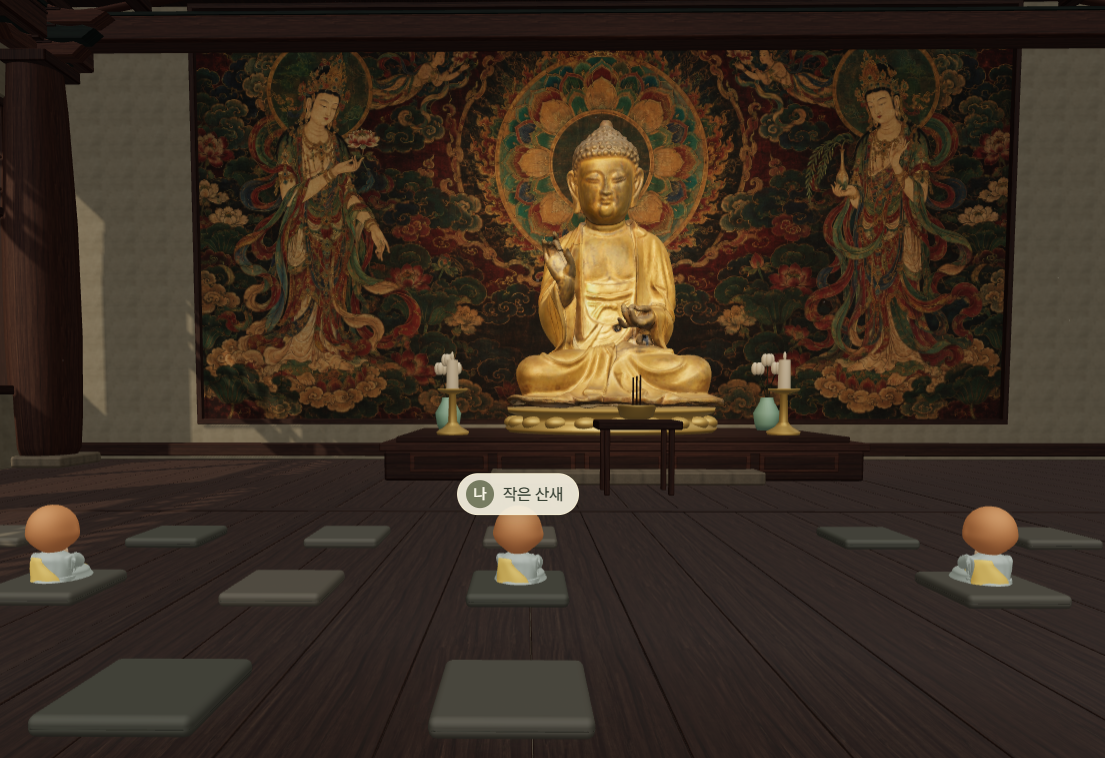
At this temple, there is no need to kneel, stand or bow. Visitors can perform 108 bows, turn prayer beads and offer prayers, all from their beds.
The temple, called Sansa, exists entirely online. It was created by a 26-year-old job seeker surnamed Park, using vibe coding, an artificial intelligence-assisted programming method that allows users to build software through natural-language instructions, according to news reports Sunday.
Visitors entering the website are greeted by a Buddhist temple nestled in a dense forest, with a large Buddha statue occupying the center of the main prayer hall. Each visitor gets an avatar that looks like a young Buddhist monk, with a randomly assigned name such as Leisurely Cloud or Soft Moonlight.
Using their avatars, visitors can wander around the temple, exchange greetings with others by pressing their palms together, kneel on cushions to perform bows, turn prayer beads and listen to Buddhist chants, creating an experience similar to visiting a real temple.
Since its launch Thursday, the virtual temple has drawn more than 100,000 visitors a day, with total visits surpassing 600,000.
The idea grew out of Park's own struggles while job hunting, when he longed to unwind at a Buddhist temple but lacked the time and energy to visit one.
"I think temples appeal to people my age because they welcome everyone, even if you're not Buddhist. Seeing so many people respond made me realize that a lot of others are just as tired as I am. Maybe all they really needed was a quiet place to take a break without having to say anything," Park told a local news outlet.
Unlike most online spaces, the site has no chat or messaging features, allowing visitors to share the same prayer hall without interacting.
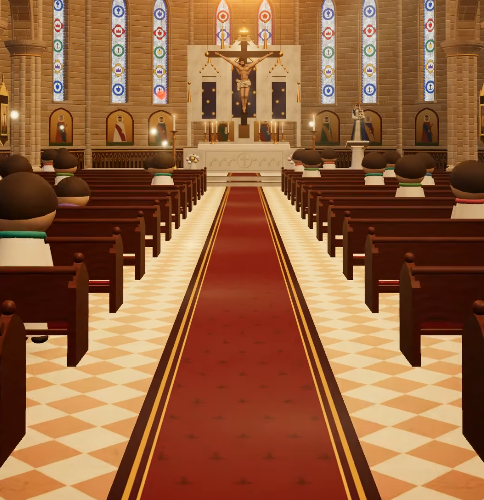
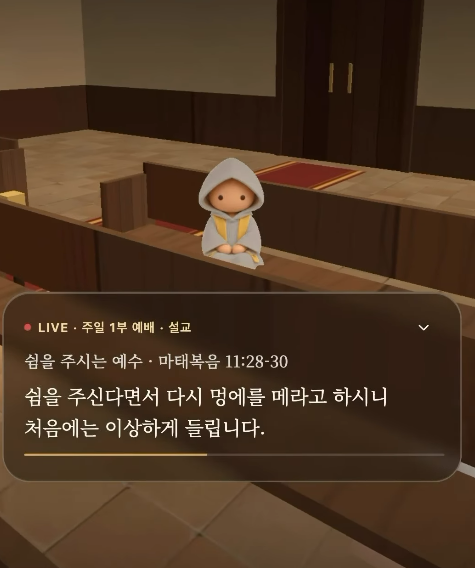
The success of the online Buddhist temple has inspired similar AI-powered platforms modeled after Catholic and Protestant churches.
One of them, Chanmi, offers a virtual Catholic church complete with pews, votive candles and rosaries. Visitors can listen to traditional hymns, while the Angelus bells ring three times a day — at 6 a.m., 12 p.m. and 6 p.m.
Another platform, Goyottul, recreates a Protestant church where visitors can share prayer requests and listen to sermons.
The popularity of these platforms reflects a growing desire among young people to find comfort in uncertain times without having to connect with others.
"Since so many young people are struggling with uncertainty in their lives, Buddhism resonates with them by acknowledging that life is full of suffering and offering ways to overcome it through their own understanding. That straightforward approach is what makes it appealing," Sung Hae-young, a professor of religious studies at Seoul National University, said.
"People want to feel a sense of peace and sacredness, like they would at a place of worship, but they don't necessarily want to be tied to a religious community or feel pressured to believe in something unquestioningly. Anonymous online spaces offer exactly that."
cjh@heraldcorp.com